
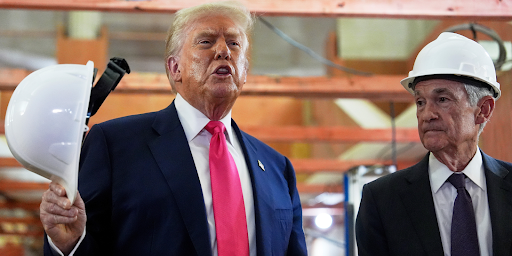
President Donald Trump, who has spent years publicly sparring with Federal Reserve Chair Jerome Powell over interest rates, is once again turning up the pressure—demanding steep cuts despite the Fed’s resistance.
At its July 30, 2025 meeting, the Federal Open Market Committee (FOMC) voted 9–2 to keep the federal funds rate at 4.25%–4.50%, defying Trump’s calls for swift action to spur growth.
Powell, Trump’s own 2018 appointee and frequent target, warned that premature easing could reignite inflation, while dissenting Governors Christopher Waller and Michelle Bowman sided with the president’s push for relief to borrowers, homeowners, and businesses.
The Federal Reserve, tasked by Congress with promoting maximum employment and stable inflation, sets U.S. interest rates through its Federal Open Market Committee (FOMC), which meets roughly eight times a year to assess economic data and adjust the federal funds rate accordingly.
Since President Trump took office in January 2025, the Federal Open Market Committee (FOMC) has met five times, and each time the Fed has held the federal funds rate steady:
- January 28–29, 2025 — Held at 4.25%–4.50%
- March 18–19, 2025 — Held at 4.25%–4.50%
- May 6–7, 2025 — Held at 4.25%–4.50%
- June 17–18, 2025 — Held at 4.25%–4.50%
- July 29–30, 2025 — Held at 4.25%–4.50%
Trump contends that lower rates would revive housing markets, boost spending, and help manage federal borrowing costs. He’s openly criticized Fed leadership and stressed the need for cheaper capital. However, Powell has steadfastly maintained the Fed’s independence, cautioning that premature easing risks undoing progress on inflation. Even with inflation gradually moderating, it remains above the target that has driven the Fed’s “higher-for-longer” approach.
Bill Pulte, the U.S. Director of Federal Housing, has emerged as Powell’s most vocal critic, frequently attacking the Fed chair’s reluctance to cut rates. A close Trump ally, Pulte has used his platform to press for aggressive monetary easing.
Interest-rate policy carries significant weight, especially for housing. A modest shift in rates can dramatically change mortgage affordability. With 30-year fixed mortgage rates still around 6.6%, according to Freddie Mac, high rates tax affordability, dampen housing demand, and slow construction—especially in markets where home prices remain elevated.
The Fed also weighs the concept of a “neutral rate”—an interest level that neither stimulates nor restrains the economy. Many economists place the neutral range near 2–3%, suggesting that current rates remain restrictive. That helps explain why Powell and most FOMC members are focused on maintaining the status quo until inflation consistently returns to target.
Markets and economic models predict that rate cuts could start later in 2025, possibly as early as September or December, depending on data. Yet some Fed officials, including Mary Daly and Raphael Bostic, have emphasized the need to remain cautious. (RELATED: Milwaukee Scrambles to Fund the Hop Streetcar After Federal Aid Expires)
Beyond its dual mandate of price stability and maximum employment, the Federal Reserve plays a central role in safeguarding the U.S. financial system. It serves as the lender of last resort during crises, supervises and regulates banks to ensure their safety and soundness, and oversees the nation’s payments infrastructure to keep money moving efficiently. (RELATED: “Out of Touch” Wisconsin Supreme Court Justice Blasts Potential Opponent)