
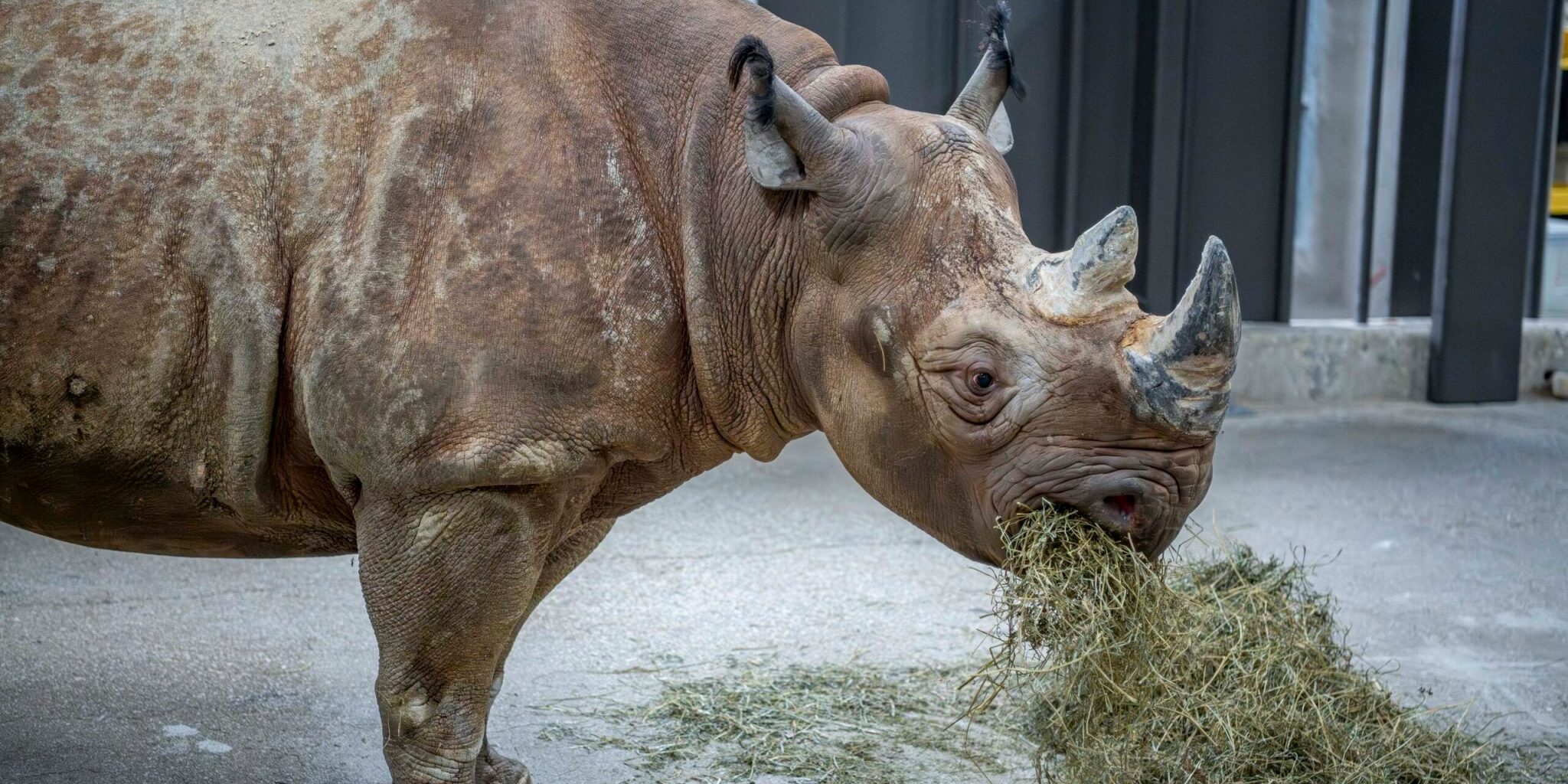
Africa is home to the world’s remaining black rhinos — a species pushed to the brink by poaching and trafficking. Now, thousands of miles away, the Milwaukee County Zoo is playing a small but meaningful role in the effort to save them.
The zoo recently welcomed two Eastern black rhinos, Zuri from the Cincinnati Zoo and Kianga from the Racine Zoo. Officials hope the pair will eventually produce offspring, contributing to the survival of a species that saw its population collapse by 98 percent in the last century.
Later this month, the zoo will open its new $22.6 million Ladish Company Foundation Rhinoceros Care Center, giving visitors an up-close look at the animals. Zoo director Amos Morris discussed the rhinos and the broader conservation program on WPR’s Wisconsin Today.
Morris said both rhinos adjusted quickly when they arrived. “From the moment they came off the trailers, they engaged with their keepers and with strangers,” he said, describing them as calm, relaxed, and highly tractable. (RELATED: Foxconn Commits Additional $569 Million to Wisconsin Facility, Aiming to Double Workforce by 2030)
For now, Zuri and Kianga remain separated by a barrier. They can smell and hear each other, but visual contact will ramp up gradually as staff prepare for a potential breeding introduction. “We’ll give them more visibility, but still protect them in case one doesn’t want to be together with the other,” Morris explained.
As a critically endangered species, the stakes are high. Morris emphasized the zoo’s dual mission: connecting visitors to wildlife and protecting the genetic health of animals cared for in accredited institutions. Both goals are supported by the Species Survival Plan, a coordinated effort that studies captive populations and recommends breeding matches based on genetics, behavior, and facility capability.
Morris, once nicknamed “the elephant guy,” said his fascination with large mammals began early despite being intimidated by their size as a child. Over time, he grew to admire what he calls their “gentle giant” nature — a perspective he now shares with the public.
With the new rhino center opening soon and Zuri and Kianga settling into their new home, the zoo hopes its work will inspire visitors while contributing to the global effort to preserve one of the world’s most imperiled species. (RELATED: American Family Field Parking Lots Could See Renovations And Improvements)